Search This Blog

Showing posts with label Saturn. Show all posts

16 September 2013

Bright Stars and Planets in the Pre-Dawn Sky

This week will see the planets Venus and Saturn in close conjunction in the sunset sky.  However, a more striking and stunning display occurs in the morning sky just before dawn.  

Looking East we find two roughly parallel lines of stars,  or rather two shallow arcs of stars.  The upper arc consists (from left to right) of the star Pollux (in Gemini), the planet Jupiter,  and the stars Betelgeuse and Rigel (in Orion).

The lower arc consists of the planet Mars, and the stars Procyon (in Canis Minor) and Sirius (in Canis Major).  

Jupiter and Sirius are by far the brightest, both being brighter than -1.6 (in the magnitude scale large positive numbers are dim while large negative numbers are very bright).  Yet these stars are some of the brightest stars in the sky; in fact Sirius IS the brightest star in the night sky.  As we slowly orbit the sun, these stars will rise about 4 minutes earlier each night, until by the time we get into winter, they will appear high in the sky around midnight.  

Not interested in getting up before dawn?  Keep an eye on the evening sky......the Harvest Moon is coming. More on that tomorrow.

Bright stars and planets in the pre-dawn sky. Created with Stellarium

15 September 2013

Venus and Saturn Draw Closer to Conjunction

If you happen to live outside the Rocky Mountain west (where it has been raining for the past week) you may have noticed two bright lights in the evening sky right after sunset.

The brightest is the planet Venus, the dimmer is the planet Saturn.  Venus is brighter because it is much closer than Saturn, even though they have about the same reflectivity (albedo).  

As the next few nights progress the two planets will slowly appear to draw closer together until on the evening of the 18th when they are just a little over 2 degrees apart.   This close approach is known as a planetary conjunction.   After the 18th Venus will drift toward the South while Saturn continues a bit to the north. 

The morning sky has 2 planets and a host of bright stars, more on that tomorrow.

Until then, clear skies, especially for those in Colorado.

Venus and Saturn in the sunset sky on September 18. Created in Stellarium

07 September 2013

Slim Crescent Moon Hints at Tomorrows Conjunction

The attempt to see the earliest hint of a crescent Moon is a challenge some sky-watchers can't resist.  After all, it is the first chance to see the Moon after it has been lost in the sun's glare for the preceding week. 

The Moon takes about 1 month to go around the Earth.  Actually  the Moon orbits the Earth once every 27 days.  But since the Earth-Moon system orbit the sun, it takes to go from one phase around to that same phase (called the Synodic period) takes 29.5 days.  As the Moon orbits the Earth, the amount of the lit side (one half of the Moon is always lit) slowly increases.  A crescent Moon is when the Moon has moved from an angle of 1 degree (i.e. the angle from the sun) to 89 degrees.  At 90 degrees from the sun the Moon is at First Quarter.  Yet the range from 1 degree to 89 degrees shows very subtle variations in how the Moon looks in the sky.  At an angle of 3 or 4 degrees, the Moon appears as a very thin sliver, while at 45 degrees it is still a crescent but much fatter.  

Tonight may be your first chance to catch a glimpse of the thinnest crescent moon.  Look for it close to the horizon in a line from Saturn and through Venus.  You should be able to see the Moon in the fading sunset.

The thin crescent Moon in the sunset sky.  Created with Stellarium

29 August 2013

September Evening Skies: Telescopic Planets, Clusters and a Comet


Time to dust off those telescopes fellow sky watchers.  The planets are putting on a show in September.  Four out of the five classic or “naked-eye” planets are visible this month, two in the evening and two in the early morning.  Telescope viewers will also want to keep an eye on Mars as it will be visible in the same field of view as a star cluster and a comet.

In the evening sky we find Venus and Saturn.  Venus is easily visible in the sunset and Saturn becomes visible after twilight.  The crescent moon also joins the fun on the evening of September 8th.  On that evening the moon will be just two degrees to the left of the planet Venus.  On the evening of the 9th it passes six degrees from Saturn.  Venus and Saturn are also drawing together for a close conjunction.  The pair slowly draw close together until by the evening of the 18th they are just 2.5 degrees apart.  At that separation the pair should easily be visible in a low power, wide field eyepiece.  

Turning to the pre-dawn sky we find other conjunctions.  The waning crescent moon passes den degrees below Jupiter on the morning of the 1st, and just seven degrees below Mars on the morning of the 2nd.  Jupiter will be very easy to spot in the pre-dawn sky, as it looks almost as bright as Venus does in the evening sky.  Mars is much dimmer but since it is the only bright point in that part of the it should be easy to spot.  The best way to locate mars is to find the twin stars Castor and Pollux in Gemini the Twins.  Mars is the orange colored point almost directly below Pollux.

The really amazing sight however occurs on the morning of the 8th.  Using binoculars or a telescope, focus in on Mars and look for a bright cluster of stars behind it.  This is M44, the Praesepe or Beehive Cluster.  Since M44 is very close to the ecliptic, any of the planets of our solar system can pass close to it.  Even a moderate powered eyepiece should show Mars and the Beehive in the same field of view.  This should also be an excellent opportunity for astrophotographers.

As if this weren’t enough, Mars will also be visible near comet ISON on the morning of the 20th.  Comet ISON is a sun-grazing comet, which means it will fly very close to the sun.  As it passes the orbit of Mars it passes what astronomers call the “frost line”, the line where solar radiation can cause the frozen gasses of the comet to sublimate (return to gas).  Whether the comet will be easily visible depends on how much it brightens as it passes Mars, something which no one can predict.  However, as it gets closer to the sun and more of the gasses sublimate it may brighten considerable, possibly even rivaling that of comet Hale-Bopp in the 1990’s.

September is a great month to get out the telescope and point them skyward.  Beginning observers have many great targets fro bright planets to a star cluster and hopefully even a bright comet.  Don’t miss these great opportunities to observe the sky and share it with your family and friends.

Conjunction of Saturn and Venus Sept 2013
 Created in Stellarium

Occultation of Mars and M44 (Beehive Cluster)
Created in Stellarium

24 August 2013

Cassini's Photo Collage

Earlier in the month I posted a short little piece about the Cassini Spacecraft (currently orbiting and studying the Saturn system) photographing Earth through Saturn's Rings.  

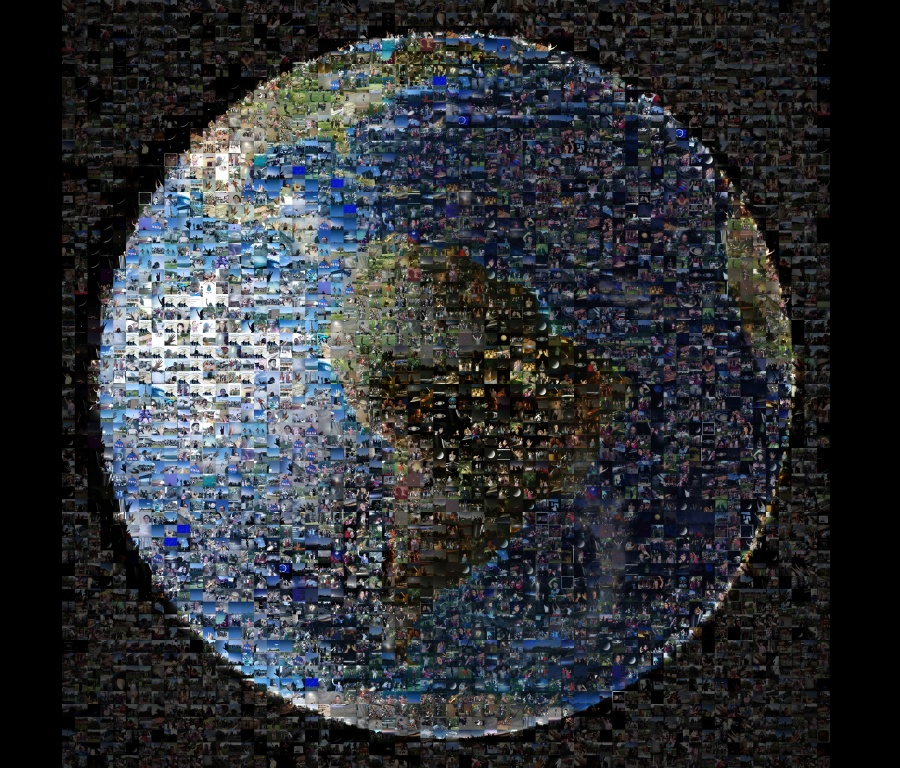
The following picture from the Cassini project is a collage of images taken from the Wave at Saturn event on July 19th.  

Photo Collage from the Wave at Saturn Event.


Earth Waves at Saturn 
Credit: NASAJPL-CaltechCassini ProjectDenizens of Earth