Search This Blog

Showing posts with label Solar System. Show all posts

12 September 2013

Never mind Elvis, Voyager has Left the Building...er...Solar System

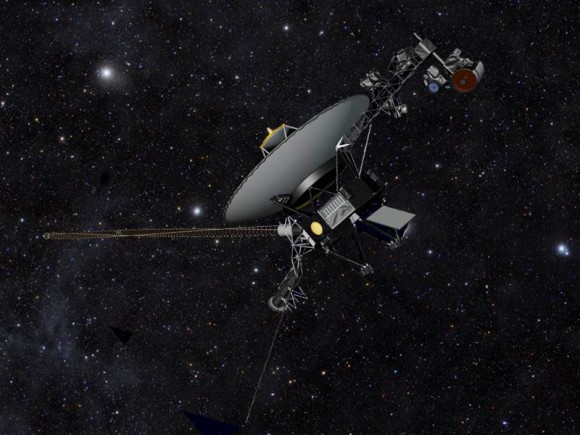
It's official, the Voyager I Spacecraft has left the solar system and is now in interstellar space.  For those two young to remember, the Voyager I spacecraft (and its twin Voyager II) were launched in 1977 to explore the outer planets of our solar system.

However, the nuclear power plant aboard Voyager has continued to provide power long after a solar panel would have become useless.  As a result Voyager continues to sample the space around it and send back radio signal to ground stations on Earth. 

Three excellent articles appeared on the Universe Today website describing how scientists arrived at the conclusion that Voyager had finally passed through the boundary where the influence of our sun ends and interstellar space begins.  


It’s Official: Voyager 1 Is Now In Interstellar Space


Listen to the Sounds of Interstellar Space, Recorded by Voyager 1

Messages To Voyager: Welcome to Interstellar Space


This artist’s concept shows the Voyager 1 spacecraft entering the space between stars. Interstellar space is dominated by plasma, ionized gas (illustrated here as brownish haze), that was thrown off by giant stars millions of years ago.Credit: NASA.

Read more: http://www.universetoday.com/#ixzz2ej5lPKit

05 September 2013

Crescent Moon Passes Venus this Weekend.

The planets of our solar system orbit the sun in a flat plane.  Looking to the night sky, we find that all the planets lie along a line known as the ecliptic.  This line is also the path the sun takes through the constellations of the zodiac.  The moon also follows along this line, but at a slightly inclined angle.

Because of this arrangement, the moon appears to  pass each of the planets as it orbits around the Earth.   This weekend is a great opportunity to see the moon pass the planet Venus.  Since both the crescent moon and the planet Venus are very bright and easy to spot, there is no mistaking them in the twilight sky.

On the evening of September 8 look to the West for the crescent moon.  Venus will be the extremely bright light to the right.  Saturn will also be visible above and to the left.  

Observers with binoculars or a small telescope (using low power) should be able to see both the crescent moon and Venus in the same field of view.  

If you miss this month's viewing, just hang around until October, when the crescent moon again passes Venus.
Venus and Crescent Moon after sunset on September 8.  Created with Stellarium


16 August 2013

Voyager 1 Most Distant Object Created by Humans

In September 1977 a little robotic spacecraft named Voyager I left the Earth to begin a tour of the solar system.  Today the Little Spaceship that Could is still out there, still flying, still sending back data and about to "leave our solar system"

That last phrase is in quotes because there is no clear dividing line between what is defined as IN and OUT of the solar system.  

The following article by Jason Major (article appeared on the Universe Today website) is a great discussion on what clues scientists will look for in Voyager's data.  

Voyager 1, Is It In or Is It Out? by Jason Major


Has Voyager 1 actually left the Solar System? Some researchers are saying yes. (Image: NASA/JPL-Caltech)