Search This Blog

Showing posts with label Sun. Show all posts

21 September 2013

Autumnal Equinox Myths Busted

The Autumnal or Fall Equinox is now known as the first day of Fall in the northern hemisphere.  It is also the first day of spring in the southern hemisphere.  

As a planetarian, I hear all kinds of strange misconceptions about the Equinox.  So lets examine some and put them to rest.

1) You can balance an egg on its end only on the Equinox (either fall or spring).  This myth implies something special about Earth's rotation or it's tilt relative to the sun.  However, the rotation and tilt are no different on the equinox than on any other date (although the neither hemisphere is tilted toward or away from the sun as on the Solstices). You can actually balance an egg on its end any time you want (if you have a few hours and nothing better to do) due to the small imperfections on the surface of the shell.

2)  The sun is directly overhead at noon on the first day of fall.  This is true only if you live at the equator.  And the sun can only be overhead between 23.5 degrees north and 23.5 degrees south, the area known as the tropics.  If you live anywhere else the sun can never be directly overhead, ever.  

3)  The sun always rises in the East and sets in the West.  Actually  on the Equinox this is true.  But this is the only  time when the sun does rise due East and sets due West.  As we move from the fall Equinox toward winter, the sun will rise progressively further toward the Southeast and set closer to Southwest.  From the Spring Equinox to the Summer Solstice the sun rises in the Northeast and sets in the Northwest.  This is because of Earth's tilt.  

4) The days and nights are each 12 hours long.  Anyone living in the northern hemisphere knows that in the dead of winter the days are short and the nights are long.  In the summer the reverse is true, the days are long and the nights are short.  The days and nights are only of equal length on...you guessed it...the Equinox (which means equal night).

The Equinox is a great time to contemplate the nature of Earth as a planet, of its tilt, it's journey around the sun and our place in the scheme of things.  Our ancient ancestors observed the sun and its path very closely because it was the very basis of their lives.  We may not observe the sun as much as we used to, but it still continues its motion with us along for the ride.

Sunrise and Sunset data for the Sun on the Fall Equinox

18 August 2013

CME Blasts Out from Sun

Here is some more information about the eruption from Sunspot 1818.  The SOHO (SOlar & Heliocentric Observatory) caught this movie of a CME (Coronal Mass Ejection) being blasted from the surface of the sun around that sunspot.  

The ionized material will probably miss the Earth, but Earth will likely pass through trailing edge of the particles so auroras are still possible.  Keep checking Space Weather for updates.

CME Off Target


17 August 2013

Sunspot 1818 Erupts

The sun is a violent place, and sunspots are both violent and unpredictable.  This movie taken from NASA's Solar Dynamic Observatory shows just how violent they can be.  

No news yet on whether Earth is in the line of fire or not so stay tuned to Space Weather  for further details.

Significan Solar Flare


14 August 2013

Hole in Sun's Corona Increases Chances for Auroras

Our sun, like all stars, is a violent place.  Huge, twisting magnetic fields, Coronal Mass Ejections and gaps in the corona that allow the solar wind to spew into space, all have the potential to cause a spectacular phenomenon here on Earth....the Aurora Borealis or Northern Lights.

This article shows us that auroras may be visible by the weekend, IF a good geo-magnetic storm gets going.

Have you taken any aurora photos?  If so I'd love to share them!  Just send them with your name, where you took them and when.  

Corona Hole Article August 14 2013

Blue areas show hole in Solar Corona.

06 August 2013

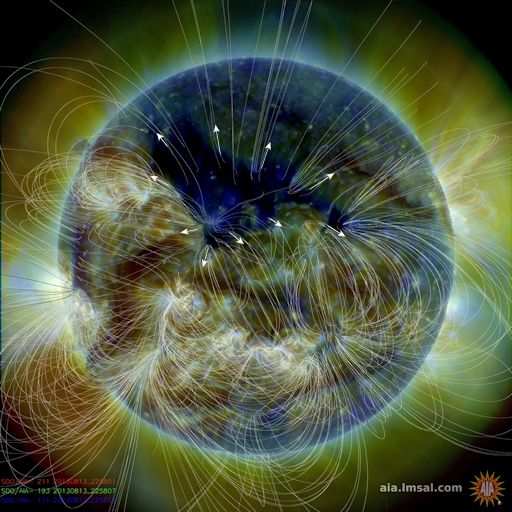
Sun's Magnetic Field about to Flip

Solar Mas is a term astronomers use to describe the time when the sun is most active.  This is usually heralded by a flip in the sun's volatile magnetic field.  Check out this article and video about this stunning event.

Sun's Magnetic Field is About to Flip


Science Cast Video: Sun's Magnetic Field About to Flip

Image courtesy of NASA

05 August 2013

The Ecliptic Makes Some Constellations Special

In the last few posts, I've talked a lot about the constellations Scorpius and Sagittarius.  Many people have heard of these two constellations but for very different, non-astronomy related reasons.  

Most people associate Sagittarius and Scorpius with the Zodiac, which of course they are.  However, the belief system of astrology and the science of Astronomy have long since parted company.  But why do we still talk about the zodiac anyway?  The reason has to do with our solar system.

Our solar system is essentially a flat disk, rather like a dinner plate.  The planets orbit around the sun within a degree or two of the plane.  This means that all the planets as well as the sun and the moon can be found along the same line in the sky.  This line is the Ecliptic.  

Ancient observers knew the planets moved differently than other stars but not why.  The considered them the gods, and so the constellations they moved through became special; what we call the Zodiac.  

In our sky there are 13 (yes thirteen not twelve) constellations that lie along the ecliptic.  Based on the division of the sky into constellations by the International Astronomical union, the sun does not spend an equal amount of time within each constellation.   

The constellations of the Zodiac are not all as bright and easy to spot as Sagittarius and Scorpius, and many might be rendered insignificant were it not for the planets passing through them.  However, Sagittarius and Scorpius are very bright, and easy to find even under light polluted skies.  

So get out there with a star wheel or sky chart and see if you can find other constellations of the Zodiac.  They will be along a line that connects Sagittarius and Scorpius and will slowly wheel from east to west as the night passes and as summer turns to fall.


Created by the Author using Stellarium